Visuals
The opportunity sites
Confidential — enter the review passcode to continue.
A data-grounded look at why housing has grown scarce and unaffordable in a nearly built-out city — and the practical, feasibility-tested strategies that can expand supply without sacrificing neighborhood character.
North Miami Beach sits at a critical juncture: home prices and rents have far outpaced local wage growth, essential workers are priced out, and a nearly built-out land base leaves little room for conventional new development. BusinessFlare® was engaged to quantify the gap and chart a realistic path forward.
The assessment analyzes five years of single-family, condominium, and rental market activity alongside demographics, workforce commuting patterns, and affordability — then translates the findings into targeted policy and opportunity-site strategies grounded in the city's actual infrastructure and zoning realities.
How can a city that is roughly 95% built out — with limited public land, aging housing stock, and infrastructure constraints — expand affordable and workforce housing without overburdening its neighborhoods? The study answers by tying every recommendation to measured housing conditions and site-by-site feasibility rather than one-size-fits-all zoning.
Five interlocking lines of analysis that move from market evidence to actionable strategy.
A diverse, growing population of ~43,676 residents drives demand at both ends: young adults and new families seeking starter homes and 1-2BR apartments, and seniors who need accessible options to downsize and age in place. Median household income (~$57,600) sits well below the county median (~$74,000), sharpening the mismatch between local earnings and housing costs.
Five years of MLS and CoStar data show active listings dropping sharply in 2021-2022 before a 2023-2024 rebound, yet supply stays tight relative to demand. The city is ~95% built out with only ~4.5% of land vacant or underutilized, over 65% zoned for low-density single-family use, and much of the stock over 50 years old.
More than 54% of renter households are cost-burdened, paying over 30% of income toward housing, while median rents (~$2,545/month) and home prices near $400,000 for typical 2-3BR units put both renting and ownership out of reach for teachers, nurses, police officers, and service workers.
A jobs-to-resident-workforce comparison — supported by Placer.ai and On-the-Map data — finds more than 82% of NMB's workforce lives outside the city, producing an estimated $220M in lost local spending each year and straining commuting infrastructure.
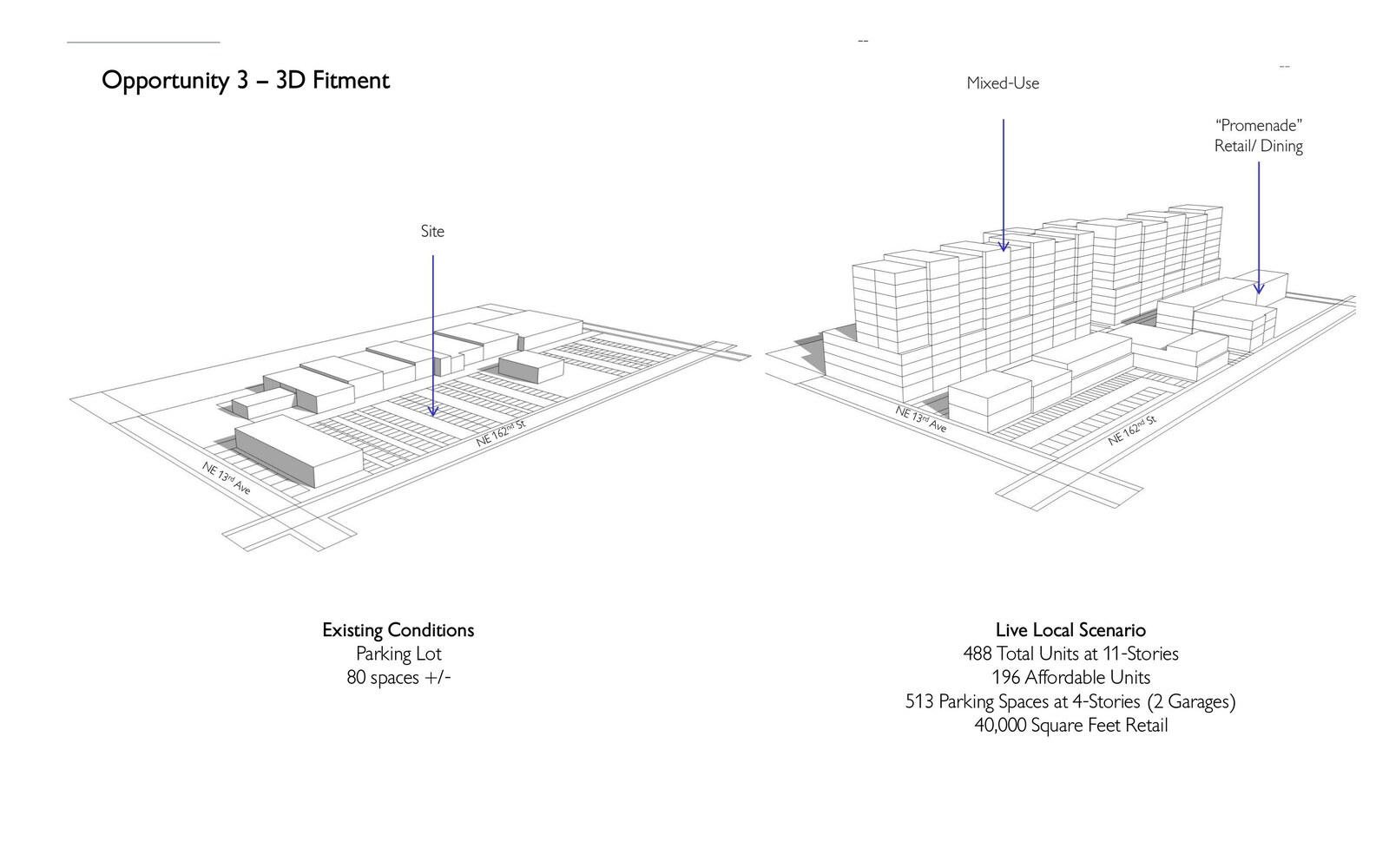
The study identifies opportunity sites, runs Fitment and Feasibility analysis on a short list of five, and lands on six integrated policy strategies — Missing Middle + ADUs (tied to sewer access), aging-multifamily revitalization, annexation of core county parcels, redevelopment of underutilized commercial parking lots along NE 163rd Street, sunsetting the legacy 'Basket of Rights' policy, and TOD near Golden Glades and Jackson North.
A three-task housing feasibility engagement covering market assessment, opportunity-site feasibility, and affordable-housing code amendments — currently in active refinement following City staff review.
Five-year market assessment across single-family, condo, and rental; demographics, workforce commuting, affordability, opportunity-site identification, and market-potential analysis. Delivered and reviewed by City staff.
Fitment and Feasibility studies on five short-listed sites — existing conditions, development capacity, conceptual program, and development/operating proformas with financing options. 3D feasibility and updated 2026 deliverables in refinement.
Policy recommendations, workshops with the Planning Board and City Commission, and a draft housing element plus implementing ordinance. 2026 updates respond to staff comments on data support and local infrastructure constraints.
Up to two public-meeting presentations and a summarizing deck; final deliverables incorporating client comments. An optional economic & fiscal impact task is available at the City's direction.